 By Classic Oldies
A Dance Between Fate and Joy: The Timeless Resilience of Love in Motion
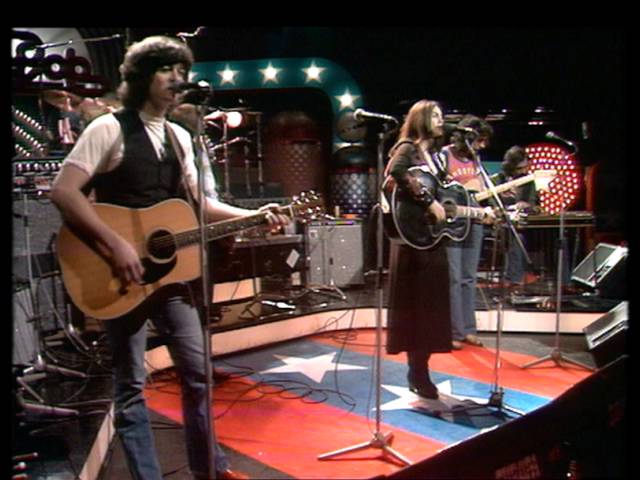
When Emmylou Harris performed “(You Never Can Tell) C’est La Vie” live on TopPop in 1977, she did more than cover a classic—she reimagined it. Originally written and recorded by Chuck Berry in 1964, the song had already achieved chart success in its own right, reaching the Top 20 in the U.S. But when Harris revived it for her 1977 album Luxury Liner, she infused it with a distinctly country-rock elegance that carried it back into the charts, where her rendition reached the Top Ten on Billboard’s Hot Country Singles chart. By the time she appeared on European television to perform it, Harris had become an emblem of the modern American roots revival—a bridge between Nashville’s storytelling tradition and California’s cosmic country renaissance.
What makes this live performance so captivating is not merely its technical precision but its emotional generosity. Harris takes Berry’s rock-and-roll fable—a story of two young lovers who build a life together against the odds—and strips it of irony, revealing instead a deep tenderness beneath its jaunty rhythm. The original version had always danced on that razor’s edge between romance and realism; Berry’s lyrics are about love’s endurance not through grand gestures but through everyday perseverance. Harris understood this implicitly. In her hands, “C’est La Vie” becomes less a toe-tapping novelty and more an ode to love’s quiet victories—the furniture bought piece by piece, the secondhand record player spinning their song night after night.
Musically, Luxury Liner was a masterpiece of balance—rooted in traditional country instrumentation yet guided by Harris’s ethereal phrasing and the crystalline production of Brian Ahern. The song itself sparkles with pedal steel sighs and crisp Telecaster runs that lift Berry’s R&B groove into a higher emotional register. Her live rendition retains that spirit but adds something ineffable: presence. Watching her on TopPop, you sense how she carries every lyric as both storyteller and witness, her voice pure but edged with longing, suggesting that she has lived every verse.
At its heart, “(You Never Can Tell)” is about time—how love matures, how joy evolves from impulse into ritual. The French phrase “C’est la vie” is no shrug; it’s an acceptance of life’s unpredictability, of beauty found in impermanence. Harris delivers it not as fatalism but as grace. She turns the refrain into affirmation: love survives because it adapts. And in doing so, she honors Chuck Berry’s original genius while making it wholly her own—a testament to how great songs live many lives, each colored by the voice that dares to tell them anew.
In 1977, as disco shimmered across dance floors and punk spat fire from basements, Emmylou Harris stood under soft studio lights and reminded the world of something simpler yet infinitely profound—that fate may be fickle, but music endures as our most faithful witness to love’s gentle revolutions.