 By Classic Oldies
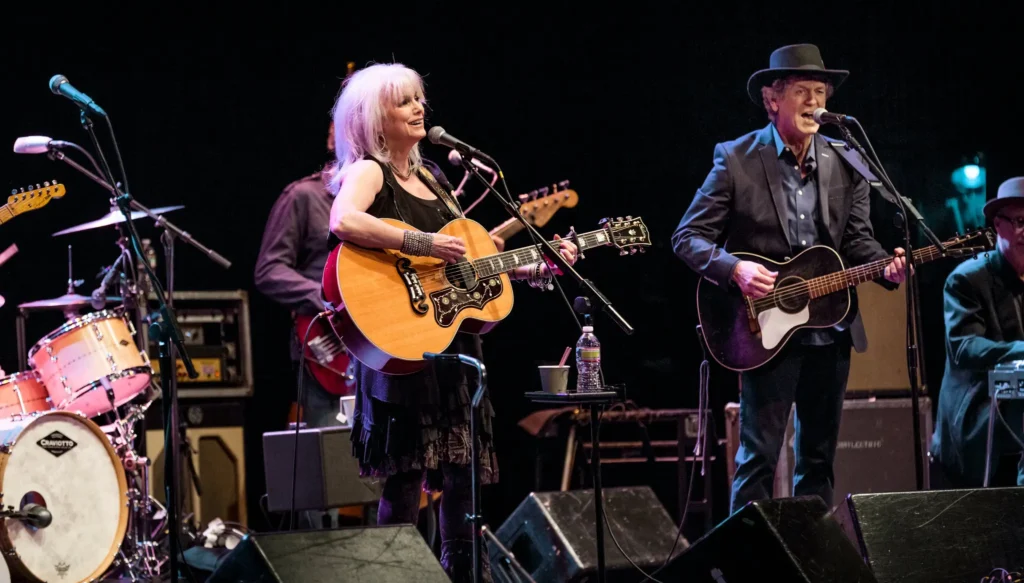
“Hanging Up My Heart” is Emmylou Harris and Rodney Crowell turning grown-up heartbreak into a quiet duet—two familiar voices admitting, without spectacle, that sometimes the bravest love is the one you finally lay down.
When “Hanging Up My Heart” appeared as the opening track of Old Yellow Moon on February 26, 2013, it didn’t feel like a “new single” trying to elbow its way onto radio. It felt like a door opening into a room you’d known all your life—warm, wood-lit, and honest. The album itself made a strong first impression on the charts: it debuted at No. 29 on the Billboard 200 (March 16, 2013)—its debut week also being its peak—and it debuted at No. 4 on Billboard’s Top Country Albums chart. Those numbers matter, not as trophies, but as proof that a quiet record—built on restraint, history, and tenderness—could still walk straight into the modern world and be welcomed.
The song’s bones are classic, too. “Hanging Up My Heart” was written by Hank DeVito, a name that carries its own deep echo in the Hot Band universe, and it was recorded for Emmylou Harris and Rodney Crowell’s long-awaited collaboration, produced by Brian Ahern. The backstory is almost novelistic in its circularity: Ahern wasn’t just any producer—he was Harris’s longtime creative partner and former husband, the steady hand behind so much of her most enduring work. So here you have a triangle made of time itself: two singers whose voices once braided through the 1970s country-rock revolution, guided again by the producer who understood precisely how to keep their sound human.
And “human” is the key word. “Hanging Up My Heart” is not a song of revenge. It’s a song of decision—the moment when emotion stops begging and starts accepting. Even the title is a kind of image you can feel: a heart like a worn coat, finally lifted from the shoulders and hung gently on a hook. Not tossed. Not burned. Just… put away. That gesture contains a lifetime of mixed feeling—love that did not become what you hoped, tenderness that couldn’t keep doing the heavy lifting, dignity returning after a long, quiet leak.
It’s also meaningful that this track was the first taste of the album offered to the public: the album notes point out that “Hanging Up My Heart” was uploaded to YouTube in December 2012, months before the full record arrived. That early preview wasn’t merely promotion—it was a signal. It told listeners exactly what kind of reunion this would be: not fireworks, not nostalgia-for-sale, but a mature conversation carried by two voices that have nothing left to prove.
Because Harris and Crowell weren’t strangers staging a duet for convenience. Their history runs deep: Crowell’s relationship with Harris’s musical world dates back to 1975, when he joined her Hot Band as a guitarist and harmony singer—years before “duets albums” were a marketing category. That long thread is why the duet sound on “Hanging Up My Heart” feels so natural. They sing like people who already know where the other breathes, where the other hesitates, where the other will soften a syllable to keep the truth from cutting too sharply.
The album’s larger arc confirms the seriousness of the project: Old Yellow Moon went on to win the Grammy Award for Best Americana Album (awarded in 2014), which is a fitting outcome for a record that trusted nuance over noise. Yet the real reward is inside the song itself. “Hanging Up My Heart” isn’t about being dramatic; it’s about being clear. It reminds us how adulthood often changes the shape of heartbreak: you don’t always slam the door—you simply close it, carefully, because you know how hard it is to build anything worth living in.
And that’s why this track lingers long after it ends. In a world that loves grand declarations, Emmylou Harris and Rodney Crowell offer something rarer: a sorrow that keeps its manners, a goodbye that doesn’t become cruel, a love that is honored even as it is released. “Hanging Up My Heart” doesn’t ask you to relive your past—it simply sits beside it, quietly, like an old friend who understands why certain songs still hurt… and why, sometimes, that hurt is the last proof that what you felt was real.