 By Classic Oldies
Fortunate Son was never just a hit record; at Royal Albert Hall in 1970, Creedence Clearwater Revival turned it into a fierce, unblinking statement about class, privilege, and who gets asked to carry a nation’s burden.
On April 14, 1970, Creedence Clearwater Revival walked onto the stage of Royal Albert Hall in London and delivered one of those performances that reminds us how a great rock song can become something larger than itself. Their version of “Fortunate Son” that night was urgent, tight, and unsentimental, all nerves and conviction. By then, the song was already deeply woven into the public imagination. First released in 1969 on Willy and the Poor Boys, and issued on a hit single paired with “Down on the Corner”, it rose to No. 3 on the Billboard Hot 100. The album itself also reached No. 3 on the Billboard 200. But in London, the song did not feel like a chart statistic. It felt like a warning siren set to a backbeat.
That is part of what makes this performance so enduring. On record, “Fortunate Son” is compact and explosive, just over two minutes of sharpened American truth. Live at Royal Albert Hall, it gained another dimension. The room gave the song space, yet the band refused to let it become grand or theatrical. John Fogerty sang it with the same clipped intensity that made the studio version unforgettable, but there was an extra edge in the hall, a sense that the message was landing far beyond the United States. London heard an American band singing about privilege, power, and selective sacrifice, and the emotion crossed every border in the room.
The story behind “Fortunate Son” is one of the most important in the Creedence Clearwater Revival catalog. John Fogerty wrote it in 1969, during the Vietnam era, when public anger over inequality was impossible to ignore. He has often explained that the song was aimed not at ordinary young men in uniform, but at the system that allowed the well-connected and wealthy to avoid the burdens placed on everyone else. One often-cited spark was the highly publicized marriage of David Eisenhower and Julie Nixon, a moment that seemed to symbolize American privilege in polished, magazine-ready form. Fogerty took that feeling and translated it into a song with almost no wasted motion. “Fortunate Son” was, and remains, an attack on unfairness dressed up as patriotic normalcy.
That is why the song still hits so hard. Its meaning is not hidden, but it is deeper than a slogan. This is not simply an anti-war song, and it is certainly not a song against working people asked to serve. It is a song about class. It is about the old wound of seeing some families asked to pay the price while others are protected by money, name, or social standing. Fogerty did not need a long lyric sheet to make that point. A few cutting lines, a relentless groove, and a voice that sounded both angry and clearheaded were enough.
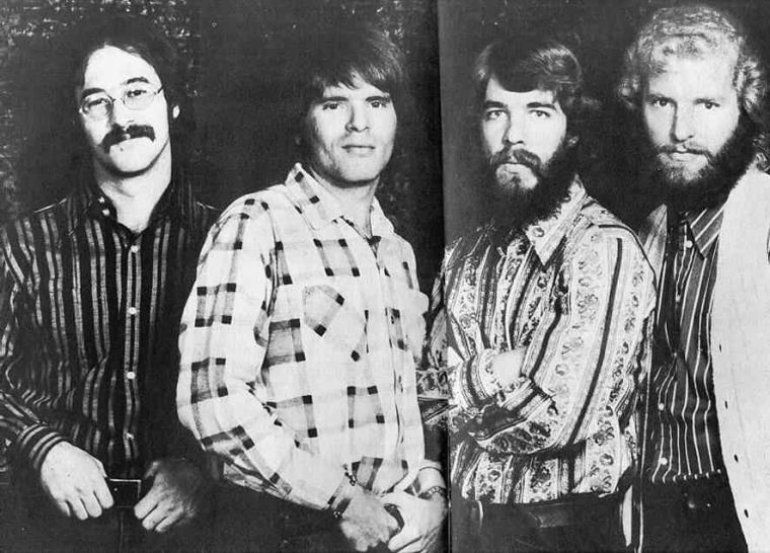
At Royal Albert Hall, the band played like men who knew exactly what kind of power they had. Doug Clifford drove the beat with a hard, marching pulse. Stu Cook kept the bass line locked to the floorboards. Tom Fogerty added the rhythm guitar texture that helped make CCR sound so muscular without ever sounding overworked. And at the center was John Fogerty, whose guitar and voice cut through the hall with no ornament, no indulgence, and no wasted gesture. That was always one of Creedence Clearwater Revival’s great strengths. They could sound enormous without bloating the song. They trusted force, clarity, and feel.
The historical importance of this particular recording has only grown with time. For many years, fans knew an album called The Royal Albert Hall Concert, released in 1980, that was later revealed not to come from London at all, but from an Oakland performance. That mistake lingered for decades. Only much later was the actual April 14, 1970, Royal Albert Hall recording properly identified and released, giving listeners the real document of that famous night. For longtime listeners, that correction mattered. There is something deeply satisfying about finally hearing the genuine room, the genuine atmosphere, and the genuine sound of CCR at one of the world’s most storied venues.
And what a setting it was. Royal Albert Hall is often associated with prestige, ceremony, and careful acoustics. Creedence Clearwater Revival brought none of the polish one might expect from a hall of that stature. Instead, they brought swamp rock, hard edges, and American plainspokenness. That contrast gave “Fortunate Son” even more bite. The song entered a grand London hall, but it did not soften. If anything, it became more defiant. You can hear the collision between elegance and raw truth, and it is thrilling.
There is also something moving in the timing. April 1970 was a peak period for Creedence Clearwater Revival. They were not a nostalgia act, not a legacy name, not a band looking back on past glory. They were in the middle of their force, carrying a run of songs that had already altered American rock. When they played “Fortunate Son” in London, it was still fresh, still hot from the era that produced it. The performance had none of the distance that later anniversary renditions sometimes carry. It was present tense. It was alive inside its own moment.
That may be why this version continues to resonate so strongly. Some songs survive because they are beautiful. Some survive because they are catchy. “Fortunate Son” survives because it still feels morally awake. And when Creedence Clearwater Revival played it at Royal Albert Hall, they gave it the kind of live reading that stripped away everything except the song’s beating heart. No grandstanding. No speechifying. Just a band at full command, and a song telling a truth that many people recognized the instant they heard it.
More than fifty years later, that London performance still sounds lean, necessary, and startlingly modern. It reminds us that the best protest songs do not age into museum pieces. They keep asking their questions. They keep pressing on old nerves. And in the hands of Creedence Clearwater Revival, “Fortunate Son” at Royal Albert Hall remains exactly what it was meant to be: a blast of rock and roll with conscience in its bloodstream.