 By Classic Oldies
A Haunting Lullaby From the Shadows of the American South
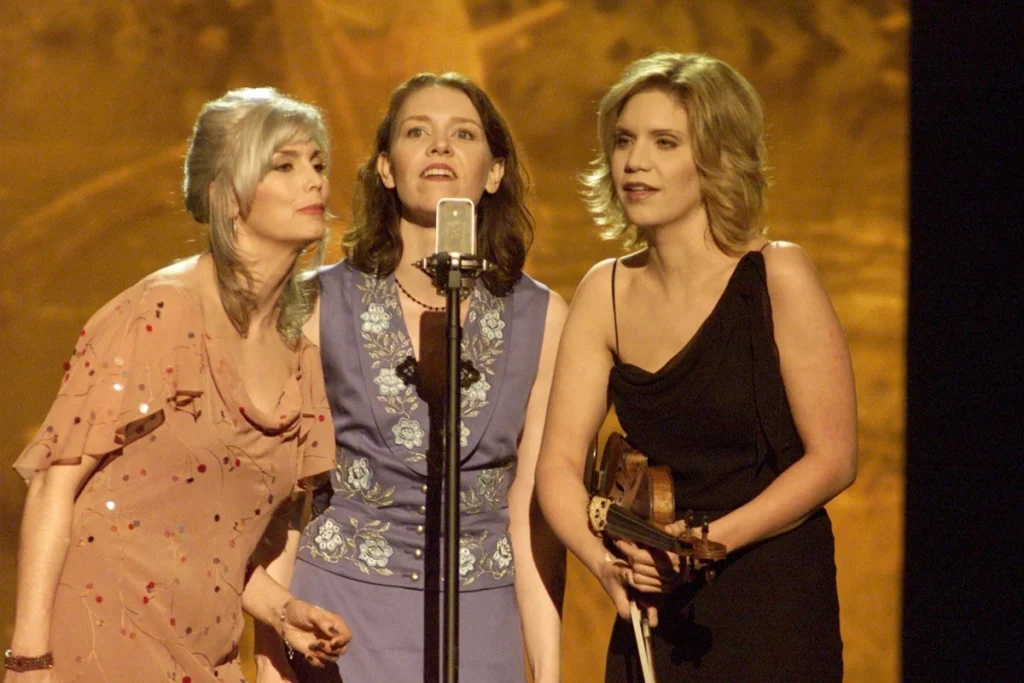
When Emmylou Harris, Alison Krauss, and Gillian Welch joined voices for “Didn’t Leave Nobody But the Baby” on the O Brother, Where Art Thou? soundtrack (2000), they summoned something ancient—something that felt less like a song than a spectral visitation. The track never charted in the conventional sense, for this was not a single designed for radio play or commercial ascendancy. Yet its inclusion on the Grammy‑winning, multi‑platinum soundtrack elevated it into cultural consciousness, becoming one of the most memorable and unsettling moments in a film already drenched in musical myth. Through this brief, hypnotic lullaby, Harris and her companions channeled a lineage of Southern folk tradition that predates recorded sound itself—a melody whispering across generations from front porches and cotton fields to Hollywood’s stylized Dust Bowl dreamscape.
“Didn’t Leave Nobody But the Baby” is a reimagined traditional lullaby, adapted by producer T Bone Burnett and director Joel Coen to evoke both comfort and unease. In its cinematic context, the song accompanies an eerie nighttime scene of three sirens luring weary travelers toward ruin—a tableau pulled from Homeric myth but steeped in Mississippi mud. Harris’s hushed alto intertwines with Krauss’s crystalline tone and Welch’s ghostly harmonies to create a texture at once maternal and menacing. The instrumentation is spare—little more than an insistent drone that feels like the earth itself humming beneath their feet—allowing the human voice to dominate, timeless and disembodied.
What makes this piece remarkable is how it reframes the familiar idea of a lullaby. The words speak softly of rest, yet there is an undercurrent of abandonment, of something irrevocably lost. It becomes a lullaby not for infants but for innocence itself. The repetition of phrases functions like an incantation: gentle on the surface but dark at its core. The singers’ harmonies blur individual identity until they become a single feminine presence—perhaps mother, perhaps siren, perhaps death herself—crooning over a world in decay.
Musically, it is minimalist Appalachian blues filtered through modern production restraint; emotionally, it sits at the crossroads of comfort and dread. That duality is central to both the film and its soundtrack’s broader revival of prewar American music: songs born from hardship yet wrapped in transcendent beauty. Harris’s performance embodies that paradox perfectly—her voice neither condemns nor consoles but merely witnesses. In doing so, she turns this fragment of folk memory into something larger: a meditation on mortality disguised as a lullaby.
More than two decades later, “Didn’t Leave Nobody But the Baby” endures as one of the most haunting testaments to Americana’s enduring power—the sound of history rocking us gently to sleep while reminding us that some dreams do not promise safe awakening.